Demonstration Site

The demonstration site will be installed within the existing Valderrobres industrial biogas plant to execute the project and validate the solutions proposed. The industrial plant is currently in operation, exploited by an invested company where both GENIA and GUCO are involved. The selection of such location is based both on the strategic participation of two members of the consortium on the current exploitation, and on the possibilities of retrofitting an existing plant, thus reducing the associated investment costs. Similarly, the logistics and pre-treatments units for pig slurry and slaughterhouse waste will be adapted for the operation for the demonstrators, so as capital and operational costs are reduced within the frame of LIFE CHANDELIER.
Project implementation
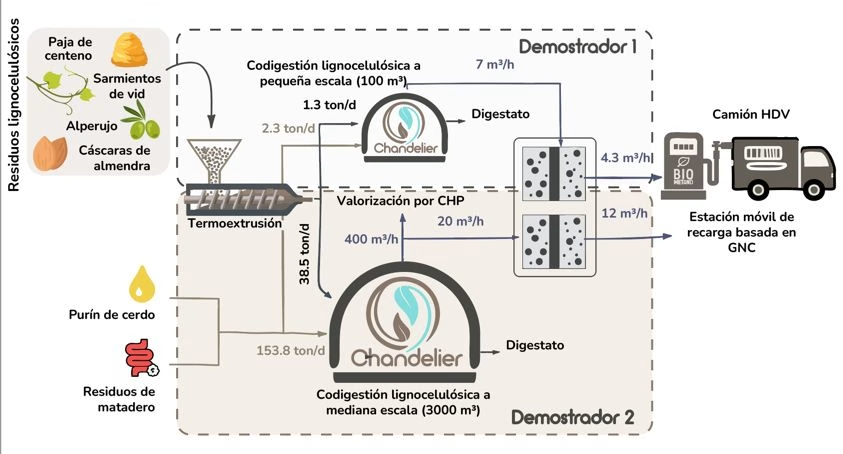
Project implementation contemplates specific preparatory actions prior the operation of the demonstrative units, especially in WP2 and WP3. Such actions involve both decentralised assays and laboratory BMP tests/physicochemical characterizations in the first 12-15 months of the project to appropriately conduct basic and detailed engineering associated to two different demonstration actions: Demonstrators 1 and 2. Later on, GENIA, GUCO and IND will cooperate for the commissioning and installation of the pre-industrial thermoextrusor, the anaerobic digester belonging to Demonstrator 1, the modular biogas upgrading unit (shared by both demonstrations), the GNC mobile recharging station and the auxiliary elements that may be required for the adaptation of Demonstrator 2 and connections between units (including protection and measuring devices, industrial water and sanitation network, instrumentation and control systems, and minor civil works that can be required).
Once commissioned and started-up, the demonstration action integrating pretreatment, anaerobic digestion and biogas upgrading, will be implemented in WP2-3 at the two different scales intended:
The pre-industrial one

Corresponding to Demonstrator 1 and simulating the small-scale anaerobic digestion.

The industrial one

Corresponding to Demonstrator 2 and simulating the medium-scale anaerobic digestion.

Both demonstrations will operate in parallel in the frame of the project.

Demonstrator 1

Small-scale biomethane production
Such demonstration will focus on validating LIFE CHANDELIER technology at a small-scale relevant environment, thus proving the enhanced biogas production of the proposed lignocellulosic-based mixtures designed. On one hand, this will include the demonstration of the innovative thermoextrusion pre-treatment, a key novelty of the project intended to boost the digestibility of lignocellulosic agri-food waste at a maximum rate of 12,000 ton/y. On the other hand, the co-digestion of different waste combinations, consisting of both current feeding streams and lignocellulosic new ones, will be carried out in short-term periods, aiming at evaluating performance and select optimal diet conditions, based on seasonability, physicochemical features and biogas production potential. The components of the proposed mixtures meet the feedstock criteria of Part A of Annex IX of the Renewable Energy Directive – Recast to 2030 (RED II), which allows the biogas and biomethane produced to be considered an advanced biofuel. The AD unit employed will be designed with a minimum volume of 100 m3, constructed and installed for such demonstration. A maximum of 2.6 ton/d mixture will be fed onto the system, the biogas and digestate productions projected at 7 m3/h and 3.2 ton/d respectively. [Please note that the digestate outlet indicated (3.2 ton/y) exceeds the waste inlet load onto the projected digester (81,200 ton/y) due to the partial recirculation of liquid fraction of digestate to dilute and adjust the content of solids at the digestion entrance.]. The biogas produced will then enter the modular biogas upgrading system designed for small- scale productions within the working range (7-20 m3/h), and the resulting biomethane (about 4.3 m3/h considering a minimum CH4 content of 95%) will be validated as vehicular fuel in GUCO’s fleet vehicles in the Matarraña region, after a previous technical validation in EUT laboratories.
Demonstrator 2

Medium-scale biomethane production

In this demonstration, the focus will be given both in enhancing biogas production at higher scale with the optimal mixture previously selected, and demonstrating the viability of the membrane-based upgrading technology at a higher scale. The thermoextrusion unit installed in Demonstration 1 will be shared for the purpose of Demonstration 2. Moreover, one of the existing AD modules at Valderrobres (3000 m3) will be adapted and used for this action. Operation will be based on i) the selected mixed diet in the aforementioned Demonstrator 1 and ii) the retrofitting given by the software model-based tools developed within the project. Total biogas and digestate production capacities at Valderrobres AD modules have been projected at 400 m3/h and 247.4 ton/d, respectively, by the end of the project. Also, the biogas upgrading module will be shared between both demonstrations, where the key operational parameters of the system (e.g., inlet biogas flow, pressure, outlet retentate and permeate flow) will be properly optimized for its operation (about 12 m3/h considering a minimum CH4 content of 95% to be produced in Demonstration 2). BioGNC will be further provided at 1.05 kg/h for further truck validation trials.